AMC MCQ syllabus and blueprint
The AMC MCQ syllabus is set by six patient groups in the AMC's V8 specifications: adult medicine 30%, adult surgery 20% and women's, child, mental and population health 12.5% each.
Updated 1 October 2026 · Checked against the sources listed below
Adult medicine · 6 questions
4 of 6
Question 1 · Adult health: medicine
A 54-year-old man sees his general practitioner because he keeps falling asleep in afternoon meetings. His wife says he snores loudly and she has seen him stop breathing for several seconds at night. His blood pressure has stayed above target despite taking perindopril, amlodipine and indapamide regularly. He does not drive. His blood pressure is 154/94 mmHg, body mass index 37 kg/m² and neck circumference 45 cm; the rest of the examination is normal. His Epworth Sleepiness Scale score is 14 and his STOP-Bang score is 6.
Which one of the following is the most appropriate next step in management?
Question 2 · Adult health: medicine
A 71-year-old woman presents to her general practitioner with a 3-week history of pain and stiffness in both shoulders and hips, worse in the morning and lasting over an hour. She has had no headache, jaw pain or visual symptoms, and no weight loss. Examination shows reduced range of shoulder and hip movement from pain, with no true muscle weakness. Erythrocyte sedimentation rate is 68 mm/h (<20) and C-reactive protein is 42 mg/L (<5).
Which one of the following is the most likely diagnosis?
Question 3 · Adult health: medicine
A 75-year-old woman attends her general practitioner (GP) because her daughter noticed a dark lesion on her scalp. She says it has been there for many years and has slowly become larger. It does not itch, bleed or hurt, and it does not catch on her comb. She has no history of skin cancer. She is not bothered by its appearance. A close-up photograph of the lesion is shown.
Clinical photograph of a skin lesionImage: Federal University of Espírito Santo (UFES), via ISIC Archive · CC BY 4.0 Which one of the following is the most appropriate management?
Question 4 · Adult health: medicine
A 32-year-old man presents to the emergency department with 2 days of sharp central chest pain that worsens with deep breaths and eases when he sits forward. He had a cold last week. His temperature is 37.6°C, pulse 96/min, blood pressure 128/76 mmHg and oxygen saturation 98% breathing room air. A scratching sound is heard at the left sternal edge. The ECG shows concave ST elevation in I, II, aVL, aVF and V2–V6 with PR depression and no reciprocal change. High-sensitivity troponin is normal at 0 and 2 hours, and bedside echocardiography shows no effusion.
Which one of the following is the most appropriate treatment?
Question 5 · Adult health: medicine
A 71-year-old woman with type 2 diabetes is recovering on the medical ward after admission for cellulitis. She takes metformin and gliclazide modified release. At 0600 hours a routine capillary blood glucose is 3.6 mmol/L. She is alert and orientated, says she feels well and has been eating normally. Breakfast will arrive in 90 minutes.
Which one of the following is the most appropriate immediate management?
Question 6 · Adult health: medicine
A 74-year-old man is brought to the emergency department after two brief episodes of loss of consciousness at home. He has no chest pain or breathlessness. His pulse is 40/min and regular, blood pressure 108/64 mmHg, respiratory rate 16/min and oxygen saturation 97% breathing room air. There is no jugular venous distension and heart sounds are normal. The ECG shown was recorded on arrival.
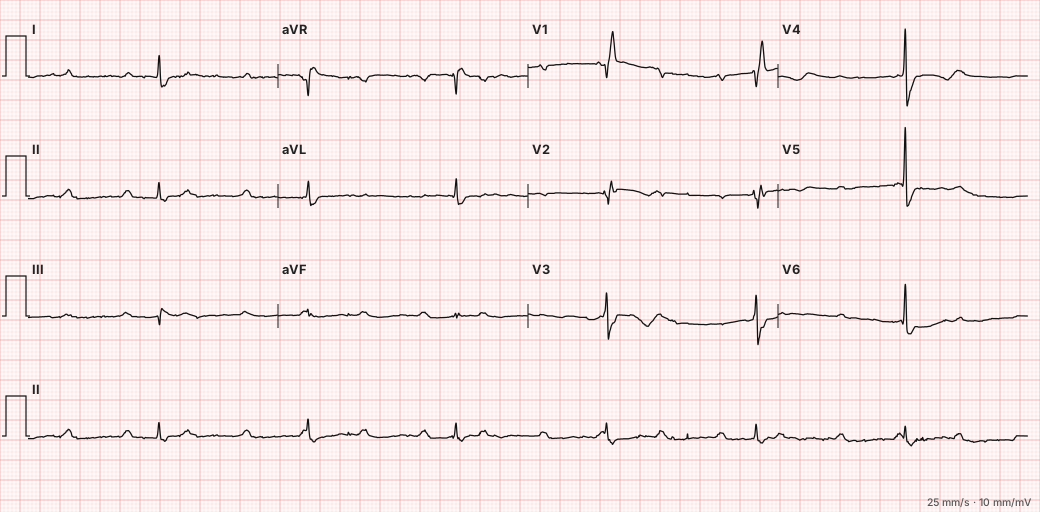
12-lead ECG with a lead II rhythm stripRendered from PTB-XL (PhysioNet) · CC BY 4.0 Which one of the following does the ECG show?
The blueprint by patient group
The AMC's MCQ Examination Specifications, version 8 (September 2025), select the 150 questions by patient group. Each group has a published weight, and the AMC describes what each one covers. Use the table as a checklist, and follow each group's link for its own practice set and revision notes.
| Patient group | AMC weight | ≈ Questions | What the AMC says it covers |
|---|---|---|---|
| Adult health: medicine | 30% | 45 | Adult health and aged care: the medical sciences, pathophysiology, clinical skills and current management, including investigations and drug and non-drug therapy |
| Adult health: surgery | 20% | 30 | The same description as medicine, with procedural interventions among the management strategies |
| Women's health (obstetrics and gynaecology) | 12.5% | 19 | Women's healthcare in gynaecology; in obstetrics, reproductive science and the effects of disease on pregnancy, labour, birth and the postnatal period |
| Child health | 12.5% | 19 | Fetal development to the end of adolescence: growth, puberty and development, including developmental disability. Common and important conditions in emergency, ambulatory, inpatient and convalescent care |
| Mental health | 12.5% | 19 | Mental disorders, illnesses and addictions at all ages: history, mental state, co-morbidities and psychological, physical and drug treatment with their risks and benefits |
| Population health and ethics | 12.5% | 19 | Screening, surveillance, vaccination, epidemiology and health promotion; professional boundaries, confidentiality, informed consent and impaired doctors; health law |
The AMC publishes percentages only. The counts are ours, from each percentage of 150, and 12.5% of 150 is 18.75. Questions are randomised across the blueprint, so the groups arrive mixed. The AMC also says population health concepts can arise in any patient group.
The three clinician tasks
Every question is also classified by clinician task. The AMC publishes no share for each task, so plan to cover all three in every group.
- Data gathering. History, mental state examination, physical examination, laboratory tests, imaging, other investigations and clinical reasoning.
- Data interpretation and synthesis. Problem identification, setting priorities, risk stratification and the differential and specific diagnosis.
- Management. Education and health promotion, counselling, drug and non-drug therapy including fluids and electrolytes, surgical and radiological interventions, rehabilitation and palliative care.
For each presentation you revise, check that you can say what to ask and order, what the results mean and what to do next.
How the AMC chooses what to examine
The standard is the knowledge, clinical skill and professional behaviour expected of a new graduate of an Australian medical school about to begin intern training. V8 describes this through the AMC graduate outcome statements in its Appendix A. Most questions reflect common clinical conditions in the Australian community. For each condition, the AMC expects knowledge of pathogenesis, clinical features, investigative findings, differential diagnosis and management.
It also includes questions critical to patient safety or outcome, and the high-yield topics page sets out those criteria by patient group.
The AMC says its questions favour common clinical applications, differential diagnosis and therapeutics, and advises care with major reference textbooks. Its free book Australian Medicine in Context covers 105 common conditions and 56 professional practice topics, and the AMC describes it as a guide to what is examinable.
Which version is current
V8, dated September 2025, is the current specification. Older editions, including one from 2011, are still found online and describe rules that no longer apply. Under V8, for example, there is no review of answers, a change the AMC flags for candidates who have sat the exam before. The AMC raised the pass standard slightly from 2026 and said the content, format and structure of the exam remain the same. The exam format guide covers timing, navigation and scoring.
Questions candidates ask
The AMC sets out the syllabus in its Multiple Choice Question Examination Specifications, currently version 8, dated September 2025, a free PDF on its website. Its free book Australian Medicine in Context covers 105 common conditions and 56 professional practice topics, and the AMC describes it as a guide to what is examinable.
The AMC blueprint gives Adult health (Medicine) 30% and Adult health (Surgery) 20%. Women's health, Child health, Mental health, and Population health and Ethics have 12.5% each. The AMC publishes percentages only; on 150 questions they come to about 45, 30 and 19 questions by our arithmetic.
No. The AMC applied a small increase to the pass standard from 2026 and said that the content, format and structure of the MCQ examination remain the same. The current specification is V8, dated September 2025.
There are no marks per patient group. The AMC scores ability rather than the number of correct answers and reports a single result on a scale of 0 to 500, with 250 as the pass. Marks are not deducted for incorrect answers.
Sources
- AMC: Multiple Choice Question Examination Specifications, V8 (September 2025)Checked 28 September 2026
- AMC: Australian Medicine in ContextChecked 28 September 2026
- AMC: Update to the AMC MCQ Examination Pass Standard (17 December 2025)Checked 23 September 2026
AMC Preparation is independent of the Australian Medical Council. Rules, dates and fees can change: the AMC is the authority, and this page is checked against it.
A first read across the six patient groups
The free diagnostic asks 12 questions across all six patient groups of the AMC blueprint in about 14 minutes and gives a first read on every subject, so you know which part of the syllabus to start with.
12 questions · about 14 minutes · free, no card details