AMC adult medicine MCQ questions
Adult health (medicine) is the AMC CAT MCQ's largest patient group, 30% or about 45 of 150 questions. Marks are lost on Australian specifics such as which test comes first.
Updated 28 September 2026 · Checked against the sources listed below
AMC CAT MCQ at a glance
- patient groups in the blueprint
- 6
- questions in one sitting
- 150
- per question on average
- 84 s
- on the 0 to 500 scale to pass
- 250
Adult medicine · 8 questions
1 of 8
- 1
- 2
- 3
- 4
- 5
- 6
- 7
- 8
Question 1 · Respiratory medicine
A 54-year-old man sees his general practitioner because he keeps falling asleep in afternoon meetings. His wife says he snores loudly and she has seen him stop breathing for several seconds at night. His blood pressure has stayed above target despite taking perindopril, amlodipine and indapamide regularly. He does not drive. His blood pressure is 154/94 mmHg, body mass index 37 kg/m² and neck circumference 45 cm; the rest of the examination is normal. His Epworth Sleepiness Scale score is 14 and his STOP-Bang score is 6.
Which one of the following is the most appropriate next step in management?
Question 2 · Rheumatology and musculoskeletal medicine
A 71-year-old woman presents to her general practitioner with a 3-week history of pain and stiffness in both shoulders and hips, worse in the morning and lasting over an hour. She has had no headache, jaw pain or visual symptoms, and no weight loss. Examination shows reduced range of shoulder and hip movement from pain, with no true muscle weakness. Erythrocyte sedimentation rate is 68 mm/h (<20) and C-reactive protein is 42 mg/L (<5).
Which one of the following is the most likely diagnosis?
Question 3 · Dermatology
A 75-year-old woman attends her general practitioner (GP) because her daughter noticed a dark lesion on her scalp. She says it has been there for many years and has slowly become larger. It does not itch, bleed or hurt, and it does not catch on her comb. She has no history of skin cancer. She is not bothered by its appearance. A close-up photograph of the lesion is shown.
Clinical photograph of a skin lesionImage: Federal University of Espírito Santo (UFES), via ISIC Archive · CC BY 4.0 Which one of the following is the most appropriate management?
Question 1 · Cardiovascular medicine
A 32-year-old man presents to the emergency department with 2 days of sharp central chest pain that worsens with deep breaths and eases when he sits forward. He had a cold last week. His temperature is 37.6°C, pulse 96/min, blood pressure 128/76 mmHg and oxygen saturation 98% breathing room air. A scratching sound is heard at the left sternal edge. The ECG shows concave ST elevation in I, II, aVL, aVF and V2–V6 with PR depression and no reciprocal change. High-sensitivity troponin is normal at 0 and 2 hours, and bedside echocardiography shows no effusion.
Which one of the following is the most appropriate treatment?
Question 5 · Endocrinology, diabetes and metabolism
A 71-year-old woman with type 2 diabetes is recovering on the medical ward after admission for cellulitis. She takes metformin and gliclazide modified release. At 0600 hours a routine capillary blood glucose is 3.6 mmol/L. She is alert and orientated, says she feels well and has been eating normally. Breakfast will arrive in 90 minutes.
Which one of the following is the most appropriate immediate management?
Question 6 · Cardiovascular medicine
A 74-year-old man is brought to the emergency department after two brief episodes of loss of consciousness at home. He has no chest pain or breathlessness. His pulse is 40/min and regular, blood pressure 108/64 mmHg, respiratory rate 16/min and oxygen saturation 97% breathing room air. There is no jugular venous distension and heart sounds are normal. The ECG shown was recorded on arrival.
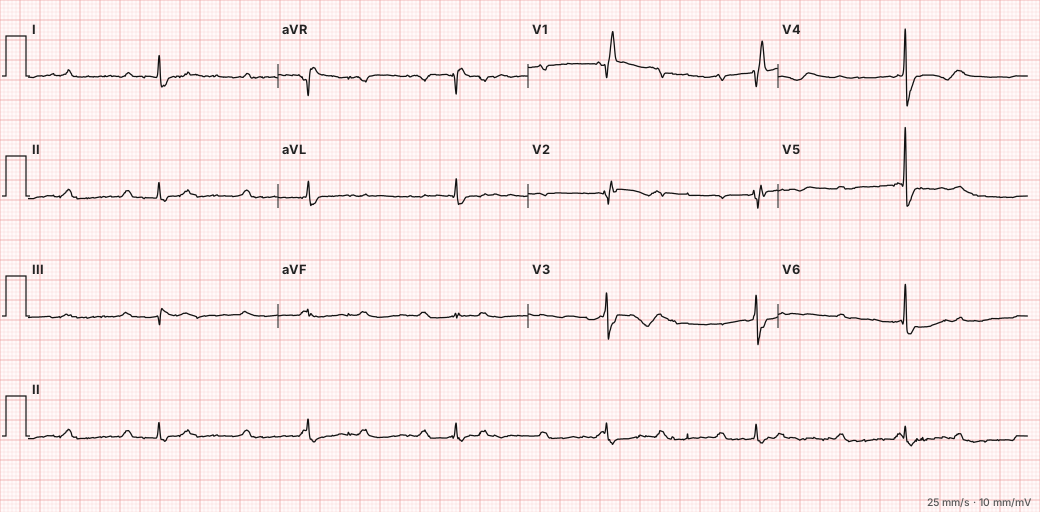
12-lead ECG with a lead II rhythm stripRendered from PTB-XL (PhysioNet) · CC BY 4.0 Which one of the following does the ECG show?
Question 7 · Toxicology, envenomation and anaphylaxis
A 64-year-old man started atorvastatin 80 mg daily 6 months ago after a myocardial infarction. Three days ago he began a 5-day course of clarithromycin for a lower respiratory tract infection. He now reports bilateral thigh and calf pain and difficulty climbing stairs, with no rash, fever or unaccustomed exercise. His weight and energy have been stable, and he has no history of thyroid disease. Examination shows mild bilateral proximal leg weakness with normal reflexes. His blood tests are shown.
Which one of the following is the most likely cause of his symptoms?
Blood tests Test Result Reference range Creatine kinase 1800 U/L 30–200 TSH 2.1 mIU/L 0.4–4.0 Question 8 · Endocrinology, diabetes and metabolism
A 42-year-old Aboriginal man attends an Aboriginal Community Controlled Health Service for a health check. He has no symptoms of diabetes. His body mass index is 24 kg/m² and he has no family history of diabetes. A colleague suggests completing the AUSDRISK questionnaire to decide whether he needs glucose testing.
Which one of the following is the most appropriate advice?
AMC CAT MCQ at a glance
- patient groups in the blueprint
- 6
- questions in one sitting
- 150
- per question on average
- 84 s
- on the 0 to 500 scale to pass
- 250
What the AMC tests in adult medicine
The AMC's examination specifications describe adult health (medicine) as a broad spectrum of adult health and aged care. It expects a foundation in physiology, biochemistry, anatomy and pharmacology, an understanding of pathophysiology and familiarity with current management: investigations, procedures, and drug and non-drug treatment. Each question is also classified by clinician task: data gathering, data interpretation and synthesis, or management.
Most questions reflect common conditions in the Australian community. Others are included because they are critical to the patient: life-threatening illness, safe practice, a successful clinical outcome or an important public health issue. The questions on this page cover cardiovascular, respiratory, endocrine, renal and acid-base, infectious disease, neurology, gastroenterology, haematology, rheumatology, dermatology, toxicology and palliative care, and the acutely unwell older patient.
Where it sits in the exam
Adult medicine is 30% of the blueprint, about 45 of the 150 questions, and the largest single group. The AMC randomises questions across the blueprint, so a medicine question may follow a paediatric or an ethics question. Medicine also shares ground with the other groups: an NSAID user with epigastric pain may be a surgical question, serotonin toxicity or alcohol withdrawal a mental health one and cardiovascular risk assessment a population health one.
Where candidates go wrong
These traps recur in our question bank, and most come from reaching for a familiar step in the wrong order.
- Anchoring on the troponin. A raised troponin with chest pain is read as myocardial infarction, when a blood pressure difference between the arms points to aortic dissection.
- The first test in the wrong place. A D-dimer is ordered when a deep vein thrombosis is already likely on the Wells score, where imaging comes first. A negative tTG-IgA is taken as excluding coeliac disease without checking for IgA deficiency.
- The slower treatment first. In hyperkalaemia with ECG changes, insulin and glucose are given before calcium, which leaves the heart unprotected while the potassium falls. In anaphylaxis, an antihistamine or a fluid bolus comes before intramuscular adrenaline. In adrenal crisis, fluids are started and hydrocortisone waits for a cortisol result.
- Oxygen by the saturation alone. Oxygen is left running because the saturation looks good, while over-oxygenation raises the carbon dioxide of a patient who retains it.
- Australian first aid and toxicology. A snakebite is washed rather than bandaged and immobilised, and a paracetamol level is taken before the 4-hour point the nomogram is built on.
How to revise adult medicine
Revise by presentation, the way questions arrive: chest pain, breathlessness, confusion, fever, a raised creatinine. For each, learn the first investigation, the finding that changes management and the Australian first-line treatment. The AMC advises care with major reference textbooks, because its questions lean towards common presentations, differential diagnosis and therapeutics, and it names Australian Prescriber and general practice journals as useful sources.
Some numbers decide the answer on their own. These are the Australian thresholds for blood pressure, diabetes and cardiovascular risk, which differ in places from guidelines used elsewhere.
| Decision | Australian threshold | Source |
|---|---|---|
| Hypertension on clinic readings | 140/90 mmHg or higher, confirmed with ambulatory or home monitoring | Heart Foundation, 2016 |
| Hypertension out of the clinic | 24-hour ambulatory average 130/80 mmHg or higher; home readings 135/85 mmHg or higher | Heart Foundation, 2016 |
| Type 2 diabetes without symptoms | HbA1c 6.5% (48 mmol/mol) or higher on two occasions, or fasting glucose 7.0 mmol/L or higher confirmed on another day | RACGP handbook |
| Type 2 diabetes with symptoms | One result is enough: HbA1c 6.5% or higher, fasting glucose 7.0 mmol/L or higher, or random glucose 11.1 mmol/L or higher | RACGP handbook |
| General HbA1c target in type 2 diabetes | 7% (53 mmol/mol), set for the individual | RACGP handbook |
| Who has a CVD risk assessment | Everyone aged 45 to 79, people with diabetes aged 35 to 79 and First Nations people aged 30 to 79 | Australian CVD risk guideline, 2023 |
| High cardiovascular risk | 5-year risk of 10% or more; intermediate is 5% to under 10% | Australian CVD risk guideline, 2023 |
Use Therapeutic Guidelines for drug choice and antibiotics, the 2025 Heart Foundation and CSANZ guideline for acute coronary syndromes, which replaced the 2016 guideline, and the Australian Asthma Handbook. The AMC's free book Australian Medicine in Context covers 105 common conditions in their Australian setting. Adult medicine pairs naturally with surgery, and the study plan guide weights both by their share of the exam.
Questions candidates ask
The AMC blueprint gives Adult health (Medicine) 30% of the 150 questions, which is about 45. Questions are randomised across the blueprint, so they arrive mixed with the other five patient groups rather than in a block.
No. The AMC blueprint has six patient groups and no separate emergency group. Acute adult presentations such as chest pain, sepsis, anaphylaxis and poisoning fall within adult medicine or adult surgery, and the AMC includes questions on life-threatening illness across the exam.
They can. The AMC says questions may contain X-rays, ECGs, scans, clinical photographs and other visual material. An adult medicine question can turn on an ECG, a chest X-ray or a set of blood results, so practise interpretation alongside management.
Therapeutic Guidelines (eTG) for drug and antibiotic choice, the Heart Foundation and CSANZ guideline for acute coronary syndromes, which was replaced in 2025, and the Australian Asthma Handbook. The AMC also names Australian Prescriber and general practice journals as useful review sources.
Sources
- AMC: Multiple Choice Question Examination Specifications, V8 (September 2025)Checked 28 September 2026
- AMC: Australian Medicine in ContextChecked 28 September 2026
- Therapeutic Guidelines Limited: Therapeutic Guidelines (eTG complete)Checked 28 September 2026
- Heart Foundation and CSANZ: Australian clinical guideline for diagnosing and managing acute coronary syndromes 2025Checked 28 September 2026
- National Asthma Council Australia: Australian Asthma HandbookChecked 28 September 2026
- Heart Foundation: Guideline for the diagnosis and management of hypertension in adults 2016Checked 28 September 2026
- RACGP and Diabetes Australia: Management of type 2 diabetes, a handbook for general practice (updated May 2026)Checked 28 September 2026
- 2023 Australian guideline for assessing and managing cardiovascular disease riskChecked 28 September 2026
AMC Preparation is independent of the Australian Medical Council. Rules, dates and fees can change: the AMC is the authority, and this page is checked against it.
Check medicine against the other five groups
Adult medicine is 30% of the exam, and a strong result here can hide a weak one elsewhere. The free diagnostic asks 12 questions across all six patient groups in about 14 minutes and gives a first read on every subject.
12 questions · about 14 minutes · free, no card details