Choosing an AMC MCQ question bank
A good AMC MCQ question bank covers all six patient groups, explains every option, follows current Australian guidelines and has mocks that allow no going back. Sample ours by group below.
Updated 26 October 2026 · Checked against the sources listed below
Adult medicine · 6 questions
4 of 6
Question 1 · Adult health: medicine
A 54-year-old man sees his general practitioner because he keeps falling asleep in afternoon meetings. His wife says he snores loudly and she has seen him stop breathing for several seconds at night. His blood pressure has stayed above target despite taking perindopril, amlodipine and indapamide regularly. He does not drive. His blood pressure is 154/94 mmHg, body mass index 37 kg/m² and neck circumference 45 cm; the rest of the examination is normal. His Epworth Sleepiness Scale score is 14 and his STOP-Bang score is 6.
Which one of the following is the most appropriate next step in management?
Question 2 · Adult health: medicine
A 71-year-old woman presents to her general practitioner with a 3-week history of pain and stiffness in both shoulders and hips, worse in the morning and lasting over an hour. She has had no headache, jaw pain or visual symptoms, and no weight loss. Examination shows reduced range of shoulder and hip movement from pain, with no true muscle weakness. Erythrocyte sedimentation rate is 68 mm/h (<20) and C-reactive protein is 42 mg/L (<5).
Which one of the following is the most likely diagnosis?
Question 3 · Adult health: medicine
A 75-year-old woman attends her general practitioner (GP) because her daughter noticed a dark lesion on her scalp. She says it has been there for many years and has slowly become larger. It does not itch, bleed or hurt, and it does not catch on her comb. She has no history of skin cancer. She is not bothered by its appearance. A close-up photograph of the lesion is shown.
Clinical photograph of a skin lesionImage: Federal University of Espírito Santo (UFES), via ISIC Archive · CC BY 4.0 Which one of the following is the most appropriate management?
Question 4 · Adult health: medicine
A 32-year-old man presents to the emergency department with 2 days of sharp central chest pain that worsens with deep breaths and eases when he sits forward. He had a cold last week. His temperature is 37.6°C, pulse 96/min, blood pressure 128/76 mmHg and oxygen saturation 98% breathing room air. A scratching sound is heard at the left sternal edge. The ECG shows concave ST elevation in I, II, aVL, aVF and V2–V6 with PR depression and no reciprocal change. High-sensitivity troponin is normal at 0 and 2 hours, and bedside echocardiography shows no effusion.
Which one of the following is the most appropriate treatment?
Question 5 · Adult health: medicine
A 71-year-old woman with type 2 diabetes is recovering on the medical ward after admission for cellulitis. She takes metformin and gliclazide modified release. At 0600 hours a routine capillary blood glucose is 3.6 mmol/L. She is alert and orientated, says she feels well and has been eating normally. Breakfast will arrive in 90 minutes.
Which one of the following is the most appropriate immediate management?
Question 6 · Adult health: medicine
A 74-year-old man is brought to the emergency department after two brief episodes of loss of consciousness at home. He has no chest pain or breathlessness. His pulse is 40/min and regular, blood pressure 108/64 mmHg, respiratory rate 16/min and oxygen saturation 97% breathing room air. There is no jugular venous distension and heart sounds are normal. The ECG shown was recorded on arrival.
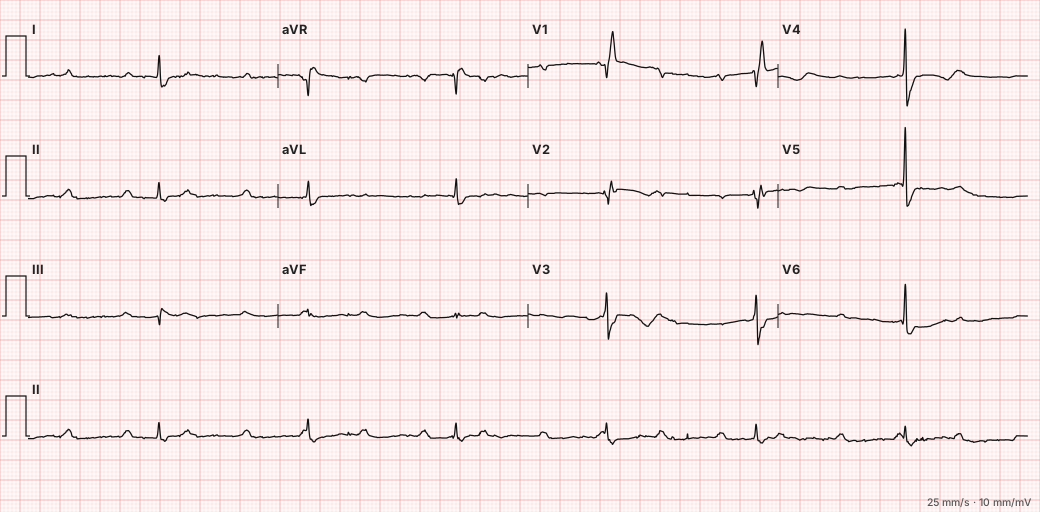
12-lead ECG with a lead II rhythm stripRendered from PTB-XL (PhysioNet) · CC BY 4.0 Which one of the following does the ECG show?
What to look for in a question bank
The AMC does not accredit or endorse any external bank, so the choice rests on what each one publishes and on its free sample. Seven points are worth checking.
- Australian guideline currency. Answers should follow current Australian guidance, such as Therapeutic Guidelines, the Australian Immunisation Handbook and the national screening programs. Guidance changed in 2025 for gestational diabetes and acute coronary syndromes.
- A rationale for every option. The AMC says other options may be partly correct. Only a rationale for all five options shows why the best answer is better.
- Blueprint coverage by patient group. The AMC gives adult medicine 30%, adult surgery 20% and the other four groups 12.5% each. A bank should say how its questions divide across them.
- Mocks in the exam's format. The exam has 150 questions in 3 hours 30 minutes, and each question must be answered before the next appears. A mock that allows going back trains a different habit.
- Image questions. The AMC says questions may include X-rays, ECGs, scans and clinical photographs. Few banks say whether they include any.
- Sources of the questions. The AMC says papers circulated as reproductions of its exam contain many incorrect stems and responses. A bank should say whether its questions are original.
- Free access. A free sample shows the standard of the explanations before any payment.
What other banks publish
The table records what each provider says on its own website. These are the providers' claims and have not been audited. Prices vary by plan and currency, so they are left to each site. All pages were read on 26 October 2026.
| Provider | Size it states | Mocks it lists | Free access it lists |
|---|---|---|---|
| AMC preparation app | 210 questions written by AMC contributors | None listed | Free with the CAT MCQ authorisation |
| PassAMCQ | "1800+ and Growing" | Two mock exams | A free trial course of 110 questions |
| AMC IMG | "1500+ MCQs" | Unlimited generated 3.5-hour exams of 150 questions | A free mock test |
| Melbourne Q-Bank | "More than 2,000" | Several time-based exams | None listed on its home page |
| AMC Wise | "3000+ MCQs" | Three mock papers of 150 questions | Three trial papers |
| AusProEd | Not stated | Online trial exams with the course | A free trial exam |
| This site | 1,999 examined questions | Four 150-question mocks | Diagnostic, mini-mock and a practice paper PDF |
The AMC's own app is the official option. Its questions are written by AMC contributors, and the app is free with the authorisation for 12 months of access. It has no mock exams listed, so candidates usually add a second source.
What ours contains
The bank holds 1,999 examined questions, all five-option single best answer. Of these, 1,351 are in the practice pool, 624 are in four full-length 150-question mock exams and 24 are in the free diagnostic.
By patient group, the bank has:
- adult medicine, 606 questions
- adult surgery, 403
- child health, 249
- mental health, 248
- population health and ethics, 248
- women's health (obstetrics and gynaecology), 245
Sixty questions include images: ECGs, imaging and clinical photographs. The platform also holds 342 knowledge notes and 1,239 recall flashcards for revision. We wrote the flashcards from our own notes, and none comes from exam content.
Every question has a rationale for every option and names the Australian guideline behind its answer. Every published item was independently examined against its sources before publication. The mocks use the exam's rule that each question is answered before the next appears. We do not use recalls. The recalls page sets out what the AMC says about them.
The AMC does not support or endorse external preparation resources, including this one. We publish no pass rate for our users. The pricing page lists what each plan includes.
How to compare before you commit
Sit the same part of the exam in each bank you consider. Use the sample above for one patient group, then repeat the group elsewhere. Compare how much each explanation teaches when you get an answer wrong. For ten questions across all groups, the AMC MCQ practice questions page offers a mixed set, and the free mock test applies the no-going-back rule.
Questions candidates ask
The AMC publishes no ranking, and the best bank depends on your gaps, your date and your budget. Compare banks on the points in the checklist above, use each free sample and check what each publishes about size, mocks and how it handles recalls.
The AMC publishes no target. Banks state sizes from about 1,500 to 3,000 questions, and the AMC's own app has 210. Coverage across the six patient groups, and a rationale for every option, matter more than the total.
The AMC's preparation app, built with eMedici, has 210 questions and is free with the CAT MCQ authorisation. Several banks offer free trial questions or papers, and ours has a free diagnostic, a free mini-mock and a free practice paper PDF.
A qbank is a bank of practice questions in the AMC CAT MCQ format: a clinical scenario, a lead-in and five options with one correct response. Some banks add mock exams, notes and flashcards.
The AMC does not require one, and it does not endorse any external resource. Candidates use the AMC's own app, Australian Medicine in Context, Australian guidelines and often a commercial bank for volume and timed practice.
The AMC says many circulated recall papers contain incorrect stems and responses, and its rules treat supplying or selling exam content as irregular behaviour. A bank of original questions avoids that risk.
Use the free sample from each. Check whether every option is explained, whether answers name a current Australian guideline, whether mocks follow the exam's no-going-back rule and whether images are included.
Sources
- AMC: Multiple Choice Question Examination Specifications, V8 (September 2025)Checked 28 September 2026
- AMC: MCQ Preparation AppChecked 23 September 2026
- AMC: Resources for international medical graduatesChecked 23 September 2026
- AMC: Australian Medicine in ContextChecked 28 September 2026
- AMC: Update to the AMC MCQ Examination Pass Standard (17 December 2025)Checked 23 September 2026
AMC Preparation is independent of the Australian Medical Council. Rules, dates and fees can change: the AMC is the authority, and this page is checked against it.
Try the bank before choosing one
The free diagnostic asks 12 original questions across the six patient groups in about 14 minutes and gives a first read on every subject, with an explanation and a named guideline for every answer.
12 questions · about 14 minutes · free, no card details