High-yield topics for AMC Part 1
The AMC publishes no high-yield list. Its MCQ criteria favour conditions critical to patient safety, life-threatening illness, safe practice or public health, such as acute coronary syndrome, sepsis, postpartum haemorrhage and the febrile child.
Updated 1 October 2026 · Checked against the sources listed below
ECGs · 1 question
1 of 1
Question 1 · Adult health: medicine
A 74-year-old man is brought to the emergency department after two brief episodes of loss of consciousness at home. He has no chest pain or breathlessness. His pulse is 40/min and regular, blood pressure 108/64 mmHg, respiratory rate 16/min and oxygen saturation 97% breathing room air. There is no jugular venous distension and heart sounds are normal. The ECG shown was recorded on arrival.
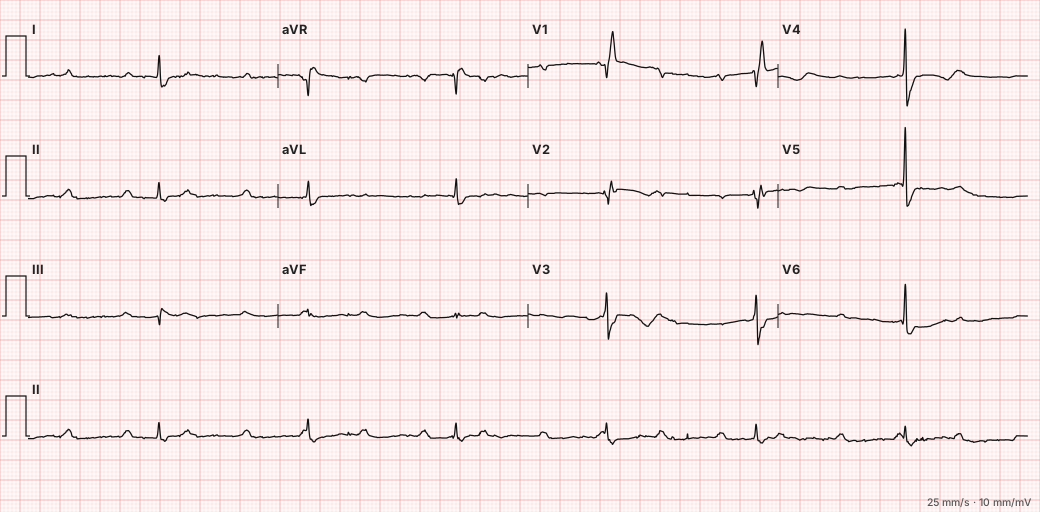
12-lead ECG with a lead II rhythm stripRendered from PTB-XL (PhysioNet) · CC BY 4.0 Which one of the following does the ECG show?
What high-yield means on this page
AMC Part 1 is the name many candidates use for the AMC CAT MCQ. The AMC's MCQ Examination Specifications do not use the term high-yield. They describe the exam as a comprehensive examination of medical knowledge and practice, and the AMC recommends a thorough review of the major topics.
The specifications do describe which questions the exam includes. Some are critical to the safety or clinical outcome of the patient. Others are based on important common conditions and meet one of four further criteria:
- related to life-threatening illness
- critical to safe practice, which includes professionalism
- successful clinical outcome
- an important aspect of public health
We use these criteria as our definition of high-yield. The selection below is ours, and it is not an AMC list. It is not drawn from recalled questions, from candidates' accounts or from claims about which topics appear most often. The AMC also says that most questions reflect common clinical conditions in the Australian community and test pathogenesis, clinical features, investigative findings, differential diagnosis and management.
Presentations that meet the criteria, by patient group
The table gives kinds of presentation in each patient group that meet at least one criterion, with the Australian guidance for each. The shares are from the AMC blueprint.
| Patient group | Presentations that meet the criteria | Australian guidance |
|---|---|---|
| Adult health, medicine (30%, about 45 questions) | Chest pain and acute coronary syndrome, acute asthma, sepsis and antibiotic choice | Heart Foundation and CSANZ acute coronary syndrome guideline 2025; Australian Asthma Handbook; Therapeutic Guidelines |
| Adult health, surgery (20%, about 30) | The acute abdomen, head injury, burns and suspected melanoma | NSW Agency for Clinical Innovation brain injury and burns guides; Cancer Council Australia guidelines |
| Women's health (12.5%, about 19) | Postpartum haemorrhage, gestational diabetes, Rh D negative pregnancy and cervical screening | RANZCOG; ADIPS 2025 consensus; Queensland Clinical Guidelines; Cancer Institute NSW |
| Child health (12.5%, about 19) | The febrile child, bronchiolitis, croup and the immunisation schedule | Royal Children's Hospital Melbourne guidelines; Australian Immunisation Handbook |
| Mental health (12.5%, about 19) | Risk to self or others, psychosis, severe mood disorder and the safe use of lithium and clozapine | RANZCP guideline library; WA guidelines on lithium and clozapine |
| Population health and ethics (12.5%, about 19) | Consent, confidentiality, the impaired doctor, notifiable diseases, national cancer screening and preventive care for Aboriginal and Torres Strait Islander people | Good medical practice (Medical Board of Australia); Ahpra mandatory notifications; NNDSS; national screening programs; NACCHO and RACGP National guide |
Most rows meet more than one criterion. Acute coronary syndrome is a life-threatening illness, lithium toxicity is a question of safe practice and screening is an aspect of public health. Each row is a starting point, and every group contains many more conditions that meet the same criteria. The AMC's free book Australian Medicine in Context covers 105 common conditions and 56 professional practice topics, and the AMC describes it as essentially a guide to what is examinable.
Testing it group by group
Work through one patient group at a time, starting with the group where your first read is weakest. For each wrong answer, name the criterion the question turned on and the Australian guidance that decides it. Several wrong answers in one row of the table mark a topic to revise before the next set.
Two kinds of question cut across the groups. The specifications say questions may contain X-rays, ECGs, scans and clinical photographs. Many emergency presentations relate to life-threatening illness, whichever patient group they belong to.
For more practice in one group, use the pages for adult medicine, surgery, obstetrics and gynaecology, paediatrics, psychiatry and population health and ethics. The preparation guide sets out the method, and the study plan turns it into a timetable.
Questions candidates ask
The AMC's MCQ Examination Specifications do not use the term high-yield. They say the exam includes questions critical to the safety or clinical outcome of the patient, and questions on important common conditions linked to life-threatening illness, safe practice, a successful clinical outcome or public health. We use those criteria to choose the topics on this page.
The AMC publishes a free book, Australian Medicine in Context, covering 105 common conditions and 56 professional practice topics, and describes it as essentially a guide to what is examinable. Its MCQ specifications also include example questions.
Adult health (medicine) has 30% of the blueprint, about 45 of the 150 questions. Adult health (surgery) has 20%, and women's health, child health, mental health and population health and ethics have 12.5% each.
The AMC describes the MCQ as a comprehensive examination of medical knowledge and practice and recommends a thorough review of the major topics. Conditions that meet its criteria are a sound place to start and to check your knowledge, and the rest of each patient group still needs to be covered.
Yes. The AMC's specifications say questions may contain images of X-rays, ECGs, scans, clinical photographs and other visual material.
Sources
- AMC: Multiple Choice Question Examination Specifications, V8 (September 2025)Checked 28 September 2026
- AMC: Australian Medicine in ContextChecked 28 September 2026
- Heart Foundation and CSANZ: Australian clinical guideline for diagnosing and managing acute coronary syndromes 2025Checked 28 September 2026
- National Asthma Council Australia: Australian Asthma HandbookChecked 28 September 2026
- Therapeutic Guidelines Limited: Therapeutic Guidelines (eTG complete)Checked 28 September 2026
- NSW Agency for Clinical Innovation: Initial management of traumatic brain injuries in adults (September 2026)Checked 28 September 2026
- NSW Agency for Clinical Innovation: Burn patient management, clinical practice guide, 5th edition (February 2026)Checked 28 September 2026
- Cancer Council Australia: Clinical practice guidelinesChecked 28 September 2026
- RANZCOG: Management of postpartum haemorrhage (C-Obs 43)Checked 28 September 2026
- MJA: ADIPS 2025 consensus recommendations for the screening, diagnosis and classification of gestational diabetesChecked 28 September 2026
- Queensland Clinical Guidelines: Rh D negative women and pregnancy, short guide (August 2025)Checked 28 September 2026
- Cancer Institute NSW: Cervical screeningChecked 28 September 2026
- The Royal Children's Hospital Melbourne: Clinical Practice Guideline, Febrile childChecked 28 September 2026
- The Royal Children's Hospital Melbourne: Clinical Practice Guideline, BronchiolitisChecked 28 September 2026
- The Royal Children's Hospital Melbourne: Clinical Practice Guideline, Croup (laryngotracheobronchitis)Checked 28 September 2026
- Australian Government: The Australian Immunisation HandbookChecked 28 September 2026
- RANZCP: Clinical guidelines and publications libraryChecked 28 September 2026
- WA Country Health Service: Specialised medication, lithium guideline (version 4.01, June 2026)Checked 28 September 2026
- WA Department of Health: Guidelines for the safe and quality use of clozapine therapy in the WA health system (version 2, June 2024)Checked 28 September 2026
- Medical Board of Australia: Good medical practice, a code of conduct for doctors in AustraliaChecked 28 September 2026
- Ahpra: Mandatory notificationsChecked 28 September 2026
- Australian Centre for Disease Control: National Notifiable Diseases Surveillance SystemChecked 28 September 2026
- Australian Government: National Bowel Cancer Screening Program, lowered eligible ageChecked 28 September 2026
- Cancer Australia: National Lung Cancer Screening ProgramChecked 28 September 2026
- NACCHO and RACGP: National guide to preventive healthcare for Aboriginal and Torres Strait Islander peopleChecked 28 September 2026
AMC Preparation is independent of the Australian Medical Council. Rules, dates and fees can change: the AMC is the authority, and this page is checked against it.
A first read across the six patient groups
The free diagnostic asks 12 questions across the six patient groups in about 14 minutes and gives a first read on every subject, so you can see which group to test first.
12 questions · about 14 minutes · free, no card details